










































Information Flow Roadmap
➤ The Number That Stops a Business Owner Cold
➤ A Story That Sounds Familiar
➤ Why the Gap Exists and Why It Keeps Growing
➤ What That Gap Is Actually Costing You
➤ System vs People: The Real Question
➤ What Business Owners Who Scale Do Differently
➤ How an Odoo Warehouse Management System Closes This Gap
➤ Three Things You Can Do This Week
➤ The Decision Behind the Decision
The Number That Stops a Business Owner Cold
Your inventory software says 500 units.
Your warehouse manager says 340.
You look at him. He looks at you. Nobody has a good answer.
Somewhere between that screen and that shelf, 160 units have quietly disappeared. And whatever they were worth has gone with them, into the gap between what your business thinks is happening and what is actually happening on the ground.
This is not a one-time mistake. This is a pattern. If you are running an SME in India today, in trading, manufacturing, distribution, or retail, there is a very high chance this pattern is already running inside your business. You just have not measured it yet.
A Story That Sounds Familiar
There is a mid-sized auto parts distributor in Pune. Good business, loyal customers, a hardworking team. They were managing inventory through Tally entries, Excel sheets updated by two different people, and a WhatsApp group where the warehouse team shared daily dispatch counts.
It worked. Until it did not.
One quarter, they ran a full physical audit. The gap between system stock and actual stock came to roughly Rs. 14 lakh. Not stolen. Not lost. Just unrecorded.
A return that came back but never got entered. A damaged batch written off in a notebook but not in the system. A sample sent to a prospect that nobody logged. Forty small mistakes, each invisible on its own, together worth fourteen lakh rupees of financial fog.
The owner was not angry. He was embarrassed. He had been making purchasing decisions, pricing decisions, and delivery commitments based on numbers that were simply not real.
Does any part of that story feel close to home?
Why the Gap Exists and Why It Keeps Growing
Most people get this part wrong. They assume the gap is a people problem. Lazy staff. Poor discipline. Careless entries.
It is not.
The gap is a structural problem. It is what happens when a growing business keeps using tools that were built for a smaller, simpler version of itself.
Think about how many times stock moves in your business on any given day. A purchase order arrives. Someone receives it and physically counts it. Someone else logs it in the system, maybe later, maybe the next morning. A sales order goes out. Dispatch happens. An entry gets made. A customer returns three units. The units sit in a corner and get logged next week. A batch fails quality check. Someone writes it in a register.
Every single one of those steps is a place where the physical world and the digital world can drift apart. In most Indian SMEs, there are anywhere between 30 and 100 such steps every single day.
The gap does not appear suddenly. It grows slowly, one missed entry at a time, until the day someone counts the shelf and shows you a number that does not match your screen.
What That Gap Is Actually Costing You
Let us be specific, because vague warnings are easy to ignore.
When your system overstates stock, your sales team commits to orders you cannot fulfill. You either delay the customer, rush-buy at a higher rate, or lose the order completely. Your margin takes the hit. Your customer’s trust takes the hit. Both at the same time.
When your system understates stock, you over-purchase. Money that could be working somewhere useful gets locked inside inventory you already had. Your cash flow tightens for no real reason.
When neither number is trustworthy, your biggest buyers start noticing. Institutional clients and larger corporates will ask for stock reconciliation before renewing a contract. If your numbers cannot hold up to that scrutiny, the relationship becomes fragile overnight.
And then there is the part nobody likes to say out loud. When there is no reliable system tracking every stock movement, small-scale pilferage becomes almost impossible to detect. A gap of 160 units might contain 20 units of deliberate theft that looks exactly like a data entry error.
A 5 to 8 percent inventory inaccuracy on a business moving Rs. 3 crore in inventory per year equals Rs. 15 to 24 lakh in silent financial exposure. Every single year.
That is not a rounding error. That is a serious business problem hiding in plain sight.
System vs People: The Real Question
Here is a question worth sitting with honestly.
How many of your inventory processes right now depend on someone remembering to do something?
If the answer is most of them, you are not running a system. You are running on trust. And trust, as any experienced business owner knows, is wonderful until it is not.
Businesses that scale reliably are not run by better people. They are run by better processes. Processes that do not require the right person to be present, in the right mood, on the right day, to function correctly.
When your experienced warehouse supervisor takes a week off, does your inventory accuracy hold? When your accounts executive resigns mid-month, does stock reconciliation still happen on time?
If either of those questions makes you uncomfortable, that discomfort is pointing at something real.
A good system captures the right information at the right moment. It makes that information visible to everyone who needs it. And it does not rely on memory, habit, or goodwill to keep running.
Is your current setup doing that?
What Business Owners Who Scale Do Differently
The founders and CEOs who build genuinely tight operations share one common quality. They stopped trusting gut feel the moment they could no longer personally verify every number themselves.
They invested in visibility before they needed it. Not after the audit disaster. Not after the customer complaint. Before it happened.
They understand that live inventory data is not a feature of a fancy software product. It is the foundation of every good business decision they make. Pricing, purchasing, delivery timelines, cash flow planning, all of it depends on knowing what is actually on the shelf right now.
They also understand that the cost of a proper inventory system is not an expense. It is protection against the kind of Rs. 14 lakh surprises that hit businesses that delayed this decision by one quarter, then one more, then one more after that.
How an Odoo Warehouse Management System Closes This Gap
This is where things get practical.
The Odoo Warehouse Management System is built around one core idea. Every movement of stock is a recorded event. Not an optional entry. Not a task someone does when they remember. A recorded event that happens as part of the workflow itself.
When a purchase order is confirmed in Odoo, a receipt is automatically created. When the warehouse team receives the goods, they validate the receipt and stock updates in real time. When a sales order is confirmed, stock gets reserved immediately. When dispatch happens, the delivery is validated and inventory adjusts instantly.
Returns, internal transfers, scrap, production inputs, every single movement flows through the same connected system.
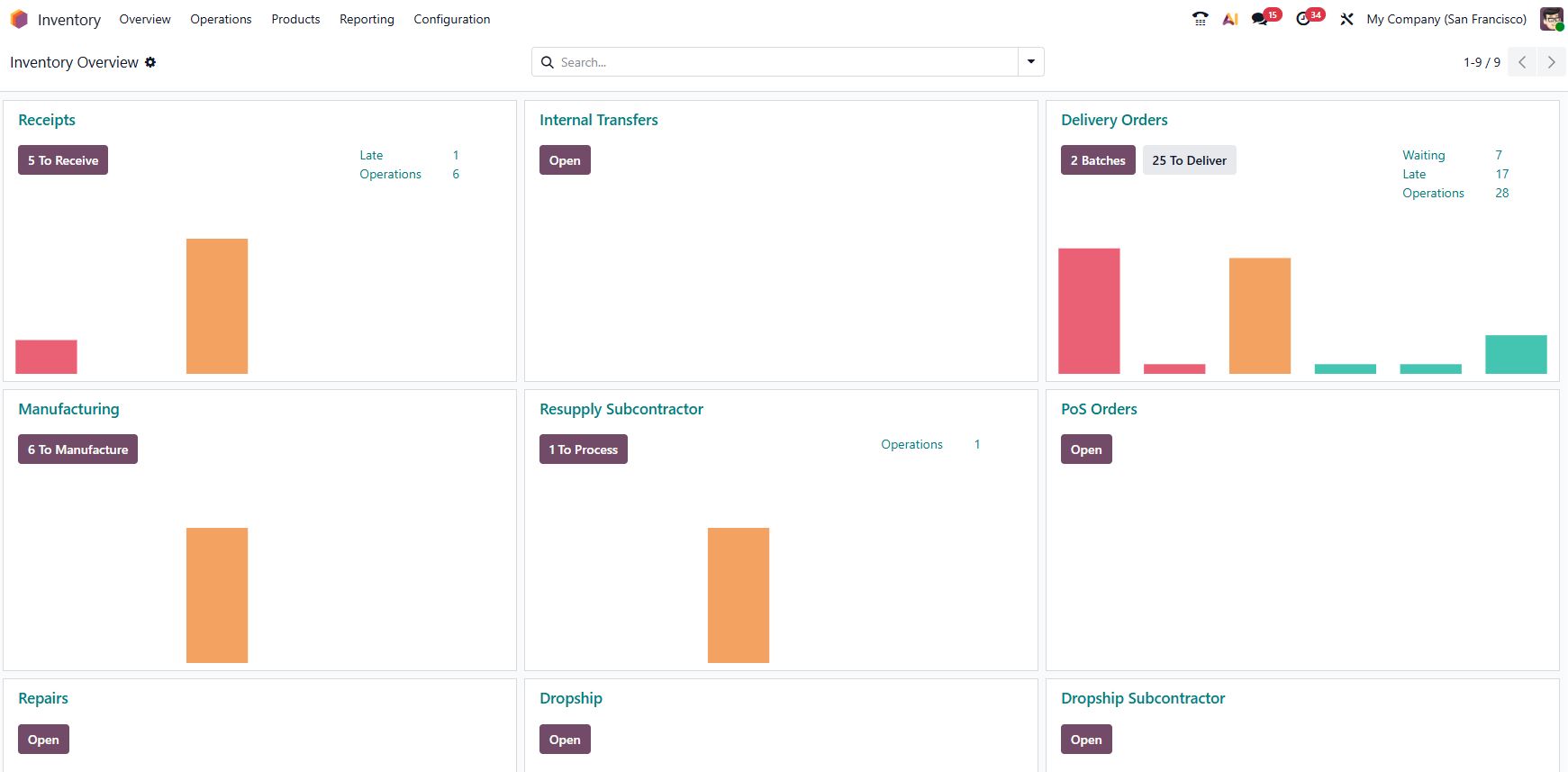
There are no parallel Excel sheets. There is no WhatsApp confirmation chain. There is no end-of-month reconciliation exercise where your team spends three days trying to explain why the numbers do not match.
The Odoo Warehouse Management System also supports barcode scanning. Physical stock movement and digital recording happen at the same moment, by the same person, in the same action. The scope for drift between physical and digital stock shrinks to near zero.
Multi-location businesses can track stock across warehouses, storage zones, and transit locations from a single screen. Automated reordering rules flag low stock before you run out, not after a customer order gets stuck.
Because Odoo is fully integrated, your inventory data connects directly to your sales, purchase, and accounting modules. When stock moves, the financial impact is recorded automatically. No manual journal entries. No month-end guesswork.
The gap between 500 and 340 does not get discovered three months later in an audit inside Odoo. It simply does not happen in the first place.
Three Things You Can Do This Week
You do not need an ERP to start understanding how serious this problem is. Here are three things any business owner can do right now.
Count your top ten products today. Pick your ten highest-value SKUs and physically count them. Compare to what your system shows. Write the difference down. If more than two or three show a gap above three percent, you have a process problem already costing you money.
Map every stock touchpoint. Write down every point where stock changes hands or location. Receiving, quality check, storage, production input, dispatch, returns, samples, damage write-offs. Mark which of those steps has a reliable digital record created at the moment it happens. Every unmarked step is a gap waiting to appear.
Calculate your real exposure. Take your total inventory value. Apply a six percent error rate. That number is your approximate annual financial exposure from inaccurate stock data. Most owners are genuinely surprised when they see it written as a rupee figure rather than a percentage.
These steps will not fix the problem. But they will show you clearly whether you have one, and roughly what it is costing you.
The Decision Behind the Decision
Choosing a proper warehouse management system is not really a technology decision.
It is a decision about what kind of business you want to run. Whether you want to keep operating on approximate numbers and periodic surprises. Or whether you want to build an operational foundation that lets you grow without constantly firefighting.
Businesses that figure this out early scale faster, waste less, and serve their customers better. They do not spend quarters explaining mismatches. They do not lose margin to invisible gaps. They do not wake up to a Rs. 14 lakh surprise during a quarterly audit.
You built this business to grow it. Not to keep explaining why the numbers do not match.
At Apagen Solutions, we are a Silver Odoo Partner. We have implemented Odoo Warehouse Management System for businesses across manufacturing, distribution, healthcare, retail, and more. The improvement in inventory accuracy is typically visible within the first 30 days.
If your physical stock and system stock are telling you two different stories, let us help you find out why and fix it permanently.
Book a Free Inventory Assessment at www.apagen.com
No long presentations. No pressure. Just a straight conversation about where your inventory process is breaking and what it will take to close the gap for good.
Because 160 missing units is not just a warehouse problem.
It is your business running on numbers it cannot trust.

