











Most construction firms do not lose money because of bad engineering. They lose it in slow approvals, untracked purchase orders, last-minute material surprises, and subcontractors billing against a budget nobody is watching in real time. By the time the accounts team flags the variance, the project is already 15% over.
If you have been managing construction costs through Excel sheets and WhatsApp messages, you are not managing them. You are guessing. And in construction, guessing is expensive.
This article walks you through why cost overruns happen on most projects, what genuine construction cost control actually requires, and how a connected ERP system like Odoo can give your team real visibility before the damage is done.
The Real Cost of ‘We Will Fix It in the Final Bill’
Talk to any project manager who has been in this industry for more than five years. They will tell you the same thing. The numbers always look fine in week three. The panic starts in week ten.
Construction cost overruns rarely happen because of one catastrophic event. They compound. A 3% materials overage here, an unlogged vendor advance there, a subcontractor invoice approved without checking the BOQ, a change order that never made it back to the budget. None of these feels fatal in isolation. Together, they quietly eat your margin.
A study by McKinsey found that large construction projects on average run 80% over budget and 20 months behind schedule. Indian infrastructure and real estate projects consistently reflect the same pattern. The problem is not money. The problem is information gaps.
Proper construction cost control software does not just store numbers. It connects the people generating costs to the people who approved the budget, in real time. That gap, between where money is being spent and where someone is watching it, is exactly where projects bleed out.
What Real Construction Cost Control Actually Needs
Before we talk about tools, let us talk about the mechanics of cost control on a construction project. Most people think it is just budgeting. It is not. There are at least five distinct layers that have to work together.
1. Budget Setup Tied to BOQ
Your cost control starts at estimation. If the bill of quantities is not structured in a way that maps directly to your purchase orders, work orders, and subcontractor contracts, you will never get accurate variance reports. Many firms build a BOQ in Excel, then re-enter it into their accounting system differently. That mismatch alone creates reporting failures.
2. Purchase and Procurement Tracking
Every material purchase, every vendor advance, every delivery should trigger a cost entry against the right project budget head. If your procurement team is raising purchase orders in isolation from the project budget, you will consistently overspend before anyone notices.
3. Subcontractor Payment Control
Subcontractor billing is one of the most common cost leakage points on any construction site. Payments often get approved based on verbal confirmation rather than verified work completion. Without a structured work order and measurement-based billing system, your subcontractor costs are essentially uncontrolled.
4. Change Order Management
Scope changes are inevitable in construction. But every change order that does not get formally logged and budget-adjusted becomes an untracked cost. Firms that handle this on WhatsApp or verbal agreements are building financial surprises into every project.
5. Real-Time Budget vs Actual Reporting
This is the piece most firms are missing. You need to see, at any point in the project, how much has been committed, how much has been invoiced, and how much is left in each budget line. If this report takes your accounts team three days to compile, it is already outdated by the time someone reads it.
Why Spreadsheets Fail at Construction Cost Control
Spreadsheets are not bad tools. They are simply the wrong tool for multi-team, multi-vendor, multi-site cost tracking at scale. Here is what breaks down in practice.
- Data is always stale. Someone updated a PO but forgot to update the sheet. Someone created a new vendor advance but it sits in a separate file. The master budget sheet becomes a historical document, not a live one.
- No approval workflows. A spreadsheet cannot enforce a three-way match between PO, goods received, and invoice. It cannot stop a payment from being processed against an overspent budget line.
- No auditability. When a budget head is overrun, good luck tracing which specific transaction caused it and who approved it.
- No connection between field and finance. The site team and the accounts team are working in parallel universes. Information travels on phone calls and emails, not systems.
This is the gap that construction cost control software is designed to close. Not just to store data, but to connect the teams and enforce the process.
How Odoo ERP Works as Construction Cost Control Software
We work with a number of construction and infrastructure firms at Apagen, and Odoo is the platform we deploy most often for mid-size projects. Not because it is the cheapest option, and not because it is the flashiest. Because it connects every cost-generating activity in a project to a single budget structure, without requiring ten different integrations to make it work.
Let us walk through each cost control layer and show you exactly what Odoo does.
Project-Level Budget Setup in Odoo
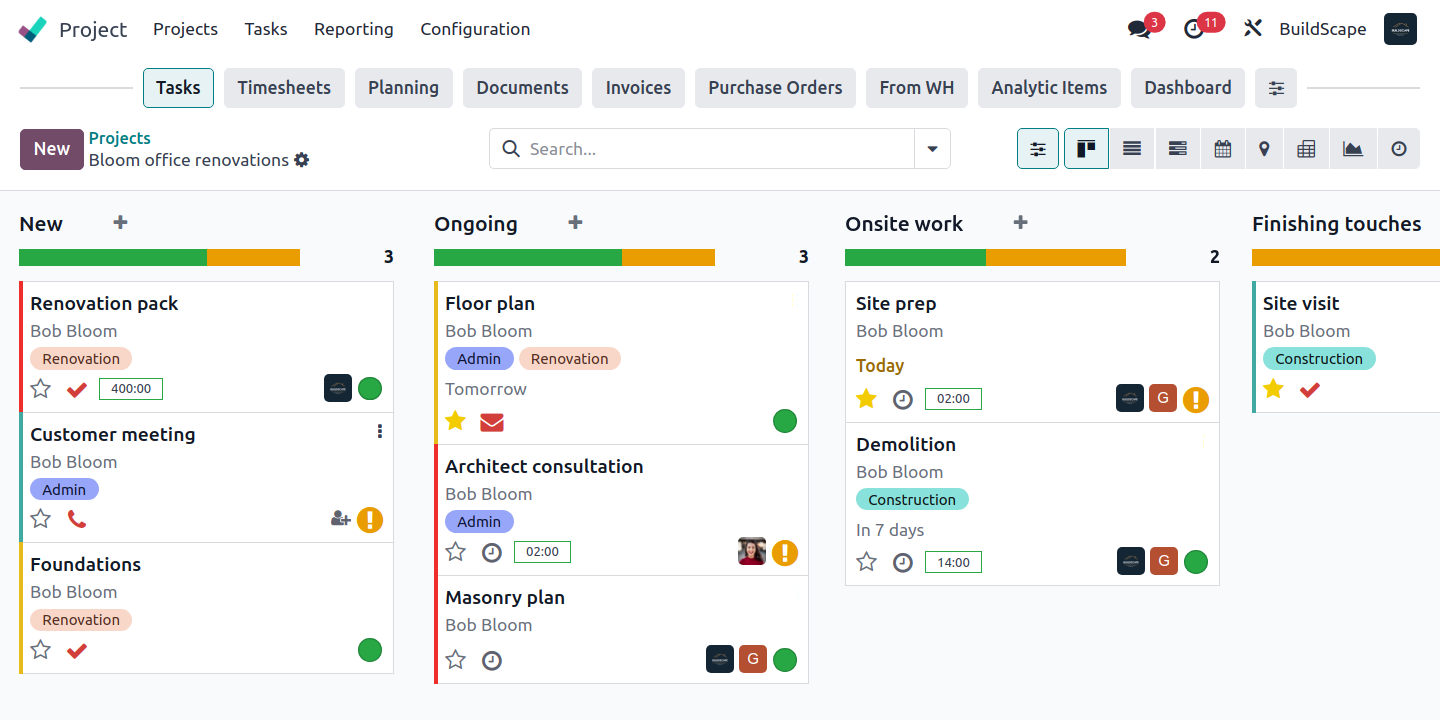
Odoo’s Project module lets you define a project budget with specific budget lines mapped to cost categories. These categories can mirror your BOQ structure directly. Every transaction in procurement, payables, or timesheets that gets tagged to this project automatically flows into the budget consumption report.
This means your project manager does not need to wait for the accounts team to compile a report. They can open the project dashboard and see budget utilisation in real time, broken down by category.
 |
Purchase Order Management with Budget Validation
This is where Odoo’s construction cost control software capability really shows its teeth. When your procurement team raises a purchase order in Odoo, the system checks it against the available budget for that project and cost head before the PO is even sent to the vendor.
If the purchase would breach the budget threshold, the system flags it and routes it for approval. You can configure multi-level approval workflows based on the purchase amount. A site engineer can approve small material purchases. Anything above a defined threshold goes to the project manager or CFO. This one feature alone eliminates a significant chunk of untracked procurement overspend.
Three-Way Matching for Vendor Invoices
Odoo enforces a three-way match between the purchase order, goods receipt note, and vendor invoice before a payment can be processed. For a construction project, this means no subcontractor or material supplier gets paid for more than what was ordered and confirmed as received on site.
This sounds obvious, but in practice most construction firms pay on invoice without consistently verifying against the original PO and goods receipt. The three-way match in Odoo makes this automatic, not manual.
Subcontractor Work Orders and Measurement-Based Billing
For construction firms dealing with subcontractors, Odoo’s manufacturing and project modules can be configured to manage work orders with defined scope and measurement milestones. Payments get processed only when the corresponding work measurement is logged and approved.
This removes the ambiguity from subcontractor billing. Both parties can see the agreed scope, the completed measurement, and the pending payment, in the same system.
Real-Time Budget vs Actual Reports
The most used feature by project managers we have worked with is Odoo’s analytic accounting report. Every cost entry, whether it is a purchase order, vendor bill, payroll entry, or expense claim, gets tagged with an analytic account corresponding to the project and cost category.
The resulting report shows you, in real time, what was budgeted, what has been committed through open POs, what has been invoiced, and what the remaining budget is. This is the core of proper construction cost control software. Not just tracking what has been spent, but what has been committed and what is coming.
Change Order Tracking as Project Amendments
When scope changes, Odoo allows you to log a project amendment or variation order as a formal document tied to the original project budget. The budget gets updated, the change is auditable, and everyone, from the site team to the finance team, can see what changed and why.
This is how you stop change orders from becoming undocumented cost surprises.
A Realistic Scenario: What This Looks Like on a Live Project
Consider a mid-size construction firm handling a commercial building project with a total budget of Rs. 8 crore. Before Odoo, their process looked like this. The procurement team maintained a separate PO tracker in Excel. The accounts team had their own ledger. The project manager got a cost update once a week, usually compiled manually by the accounts head.
By the time the project reached 60% physical completion, the firm had consumed 72% of the budget. Nobody had flagged it because no single system was connecting procurement commitments to budget consumption.
After deploying Odoo as their construction cost control software, the same firm ran their next project with a single dashboard where every PO was tagged to the project budget in real time. At 60% physical completion, their budget consumption was 58%. The project manager could see three specific budget heads that were trending above plan and made decisions early enough to course correct.
The difference was not discipline or intention. The difference was visibility.
Common Mistakes Construction Firms Make When Implementing Cost Control Software
We see these patterns repeatedly when firms try to implement construction cost control software for the first time.
- Setting up the software but not training the procurement team. If the site team continues to raise POs outside the system, your real-time budget reports are fiction.
- Not mapping the chart of accounts to the project BOQ. If cost categories in your ERP do not match the way you estimated the project, variance reports become useless.
- Treating it as a finance tool, not a project management tool. Construction cost control software only works when the site team, procurement team, and finance team are all inside the same system.
- Going live on all features at once. Start with purchase order control and budget tracking. Add layers once the team is comfortable with the basics.
- Skipping the analytic account tagging. This is the single most common technical mistake. If transactions are not tagged to the right project and cost head, your reports will always be incomplete.
Frequently Asked Questions
What is construction cost control software?
Construction cost control software is a digital system that connects your project budget, procurement, vendor payments, and subcontractor billing into a single platform. It gives project managers and finance teams real-time visibility into how much of the project budget has been spent, committed, and is remaining at any point in the project.
Can Odoo ERP be used as construction cost control software?
Yes. Odoo’s combination of project management, analytic accounting, purchase management, and vendor payment modules can be configured to serve as a comprehensive Odoo construction cost control software. We at Apagen have deployed it for construction and infrastructure clients across different project sizes and complexities.
What is the difference between project budgeting and cost control?
Budgeting is what you plan to spend. Cost control is the ongoing process of making sure actual and committed costs stay within that plan. You need both, and they need to be connected. A budget in one system and purchase orders in another gives you budgeting but not cost control.
How does a three-way match help in construction cost control?
A three-way match compares the original purchase order, the goods received note from site, and the vendor invoice before payment is released. This prevents overpayment, ensures quantities match what was actually delivered, and creates a clear audit trail for every rupee spent on the project.
Is Odoo suitable for small and mid-size construction firms in India?
Odoo is one of the few ERP platforms that scales well for Indian SMEs in construction. The licensing model is flexible, the modules can be phased in over time, and the platform is available in Indian languages and supports GST-compliant invoicing natively. For firms running projects between Rs. 2 crore and Rs. 100 crore, Odoo is typically the most practical and cost-effective option.
The Bottom Line
Construction cost overruns are not inevitable. They happen when information moves too slowly between the people creating costs and the people responsible for the budget. The right construction cost control software does not add bureaucracy to your project. It closes the information gap that lets small overruns grow into project-level losses.
Odoo ERP, when configured correctly for construction projects, gives you that visibility at every stage. From purchase order approval to vendor payment, from subcontractor billing to change order management, every cost-generating action is connected to the project budget in real time.
If you are running construction projects and your cost reports are still being compiled manually at the end of each week, that delay is costing you more than you realise.
| Want to See How This Works for Your Projects?
We help construction and infrastructure firms implement Odoo ERP as a practical construction cost control software, configured to match your actual project workflow. No generic demo. A real conversation about your specific challenges. Reach out to the Apagen team to discuss your project requirements. |