
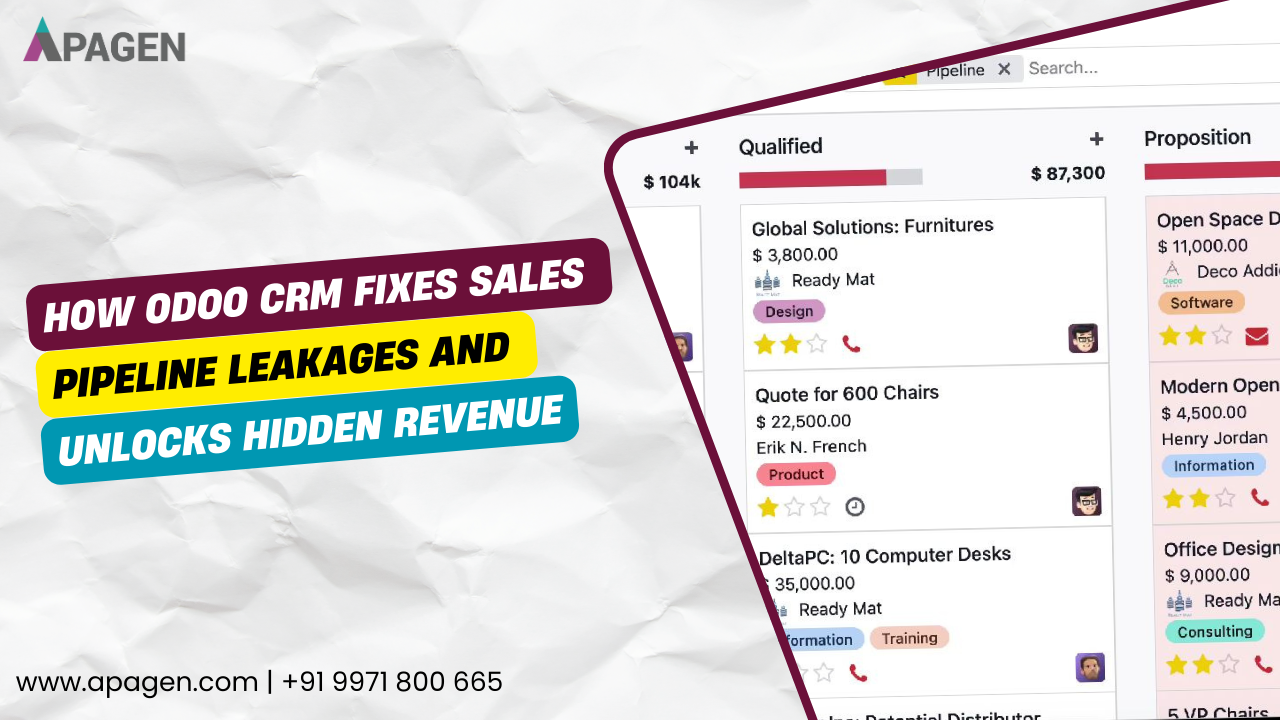
How Odoo CRM Fixes Sales Pipeline Leakages and Unlocks Hidden Revenue
Sales leaders across industries face a common frustration. Even with a CRM system in place, revenue outcomes remain unpredictable. Pipelines look active, opportunities show healthy probabilities, and forecasts appear confident. Yet, when the month or quarter ends, a large portion of expected revenue does not convert.
From our experience at Apagen, working with organizations across manufacturing, engineering, EPC, services, and distribution sectors, this challenge is rarely caused by a lack of leads. More often, it is the result of hidden sales pipeline leakages such as missed follow-ups, unclear stage definitions, and limited visibility into real sales activity.
This ERP thought leadership article explores how Odoo CRM, when implemented with the right structure and intent, helps businesses fix these leakages and unlock revenue that is already present in the pipeline. The insights shared are drawn from real implementations and observations from a practical Odoo CRM Demo focused on day-to-day sales realities rather than feature-driven presentations.
The Reality Behind Most Sales Pipelines
On the surface, most sales pipelines appear healthy. Opportunities are spread across stages, probabilities are assigned, and projected revenue numbers look promising. However, when pipelines are reviewed closely, a different reality often emerges.
Deals remain stuck in early stages for weeks while still showing high probabilities. Follow-up activities are overdue or missing. Sales managers struggle to understand why some opportunities stall while others close quickly with fewer interactions. The CRM shows numbers, but not clarity.
This challenge is especially common in growing organizations, and Odoo CRM for small businesses addresses this gap effectively. Smaller teams often operate with limited resources, where even a few missed follow-ups or stalled deals can significantly impact monthly revenue. In such environments, pipeline discipline and visibility are essential.
These gaps create what can be described as a pipeline illusion. The pipeline suggests momentum, but actual sales behavior does not support it. Over time, this results in 30 to 40 percent of potential revenue leaking out silently.
Why Sales Pipeline Leakages Go Unnoticed
Sales pipeline leakages rarely occur due to lack of effort. They happen because most CRM systems allow flexibility without accountability.
Common leakage points include deals moving forward without completing real milestones, follow-ups dependent on individual memory, probabilities based on intuition rather than actions, and limited shared visibility into overdue activities. In many cases, leadership becomes aware of these issues only during monthly or quarterly reviews, when recovery is no longer possible.
When pipelines lack structure, flexibility turns into ambiguity. This is where many CRM implementations fail to deliver long-term value.
Redefining Pipeline Stages as Real Business Milestones
One of the most impactful changes we implement for clients is redefining pipeline stages.
In Odoo CRM, stages are not just labels on a kanban board. They can be designed to represent real, measurable sales milestones such as lead qualification, proposal shared, negotiation initiated, or final approval. When stages align with real actions, the pipeline begins to reflect reality rather than optimism.
At Apagen, we start pipeline design by understanding how sales actually happens within the organization. Only then do we configure stages to match those workflows. Stages can be visually structured using colors and folding logic and associated with specific sales teams where required.
When stages have clear meaning, fake progress naturally disappears. Opportunities move forward because something meaningful has occurred, not simply because the system allows it.
Follow-Up Discipline as a Revenue Protection Mechanism
Across industries, one of the most common reasons for deal loss is simple. No follow-up happened at the right time.
In many organizations, follow-ups live in personal calendars, notes, or memory. As workloads increase, these reminders are missed, and leads quietly go cold. The pipeline often does not reflect this deterioration until it is too late.
Odoo CRM addresses this by making follow-ups visible and shared. Activities linked to leads and opportunities are clearly displayed, and overdue tasks are highlighted in real time. This visibility is not limited to salespeople but extends to managers and leadership teams.
From an operational perspective, this shared transparency creates accountability without micromanagement. Sales teams become more consistent, and managers can intervene early rather than reacting after opportunities are lost.
Using Automation to Reduce Dependency on Human Memory
Sales processes that rely heavily on human memory are inherently fragile. Important emails, follow-ups, and internal updates are often delayed or forgotten, especially in fast-paced environments.
This is where automation becomes a strategic advantage.
In Odoo CRM, automated activities can be triggered based on specific conditions. For example, when a lead is marked as qualified, a welcome email can be sent automatically. When an opportunity enters a specific stage, a follow-up task can be created. If an activity remains incomplete beyond a defined timeframe, alerts or escalations can be triggered.
This approach is particularly valuable for Odoo CRM for small businesses, where salespeople often manage multiple responsibilities. Automation ensures that critical sales actions continue consistently without increasing operational overhead.
Lead Scoring to Improve Focus and Conversion Rates
Not all leads deserve equal attention, yet many sales teams treat them the same. This results in high effort spent on low-potential opportunities and insufficient focus on leads that are more likely to convert.
Odoo CRM includes lead scoring capabilities that help teams prioritize intelligently. Lead scores can be influenced by data completeness, lead source, engagement level, and recent activity history. While probabilities can be manually adjusted or defined at the stage level, lead scoring adds a data-driven layer to decision-making.
In practice, this helps sales teams focus on opportunities with realistic conversion potential, improving productivity and shortening sales cycles.
Real-Time Visibility for Sales Leadership
One of the biggest challenges for sales leadership is discovering pipeline issues too late. Traditional reporting methods often rely on spreadsheets or manually prepared reports, which reflect the past rather than the present.
With Odoo CRM, reporting and forecasting are available in real time. Sales leaders can analyze expected revenue by period, monitor deal aging, review stage-wise conversions, and identify bottlenecks instantly. Dashboards provide a consolidated view of closure rates, lead sources, lost reasons, and product performance.
This level of visibility enables proactive decision-making and eliminates surprises at the end of the month.
Turning CRM into a Sales Operating System
A well-implemented CRM should not feel like an administrative burden. It should function as a sales operating system that supports daily decision-making.
Insights from a practical Odoo CRM Demo show that when pipelines are designed around real workflows, automation rules are purposeful, and dashboards reflect leadership needs, the CRM becomes an enabler rather than a constraint.
At Apagen, we consistently see that technology alone does not fix sales problems. Alignment does. When CRM design aligns with how teams actually sell, results become predictable and scalable.
You May Not Need More Leads
A recurring realization for many organizations evaluating Odoo CRM for small businesses is that growth does not always require more leads. Often, the real opportunity lies within the existing pipeline.
Hidden revenue is commonly found in stalled opportunities, missed or delayed follow-ups, poorly defined pipeline stages, and limited management visibility. By addressing these leakage points, businesses can unlock growth without increasing marketing spend or expanding sales teams.
From Pipeline Visibility to Revenue Predictability
Sales pipeline leakages rarely happen suddenly. They occur quietly through small gaps that compound over time. Odoo CRM, when implemented with experience and intent, helps close these gaps by introducing structure, visibility, and practical automation.
From our experience at Apagen, successful CRM adoption is less about features and more about execution. When the system reflects real sales behavior, teams gain control, leadership gains clarity, and revenue outcomes become more predictable.
In many cases, the growth businesses are looking for is already present in their pipeline. It simply needs to be unlocked.
Frequently Asked Questions
What are sales pipeline leakages?
Sales pipeline leakages occur when potential deals fail to convert due to missed follow-ups, stalled opportunities, unclear pipeline stages, or lack of visibility. These issues often go unnoticed and can result in 30 to 40 percent of potential revenue being lost.
How does Odoo CRM help fix sales pipeline leakages?
Odoo CRM helps fix leakages by introducing structured pipeline stages, visible follow-up tracking, automation-driven activities, lead scoring, and real-time reporting. This allows teams to identify stalled deals early and take corrective action.
Is Odoo CRM suitable for small businesses?
Yes. Odoo CRM for small businesses is highly effective due to its flexibility and scalability. Small teams benefit from automation, simplified pipeline management, and real-time visibility without increased administrative effort.
What is included in an Odoo CRM Demo?
An Odoo CRM Demo typically covers lead and opportunity management, pipeline stages, follow-ups, automation, lead scoring, dashboards, and forecasting based on real sales scenarios.
Can Odoo CRM improve sales forecasting accuracy?
Yes. Odoo CRM provides real-time forecasting based on live pipeline data, deal stages, probabilities, and activity history, enabling more accurate and data-driven forecasts.
What’s the Next Step?
If your sales pipeline looks active but struggles to convert, it may be time to review how your CRM is designed and used.
At Apagen, we work closely with sales and leadership teams to assess real sales behavior, identify pipeline leakages, and align Odoo CRM with practical, day-to-day workflows. Whether you are refining an existing setup or exploring insights through an Odoo CRM Demo, a structured review often reveals hidden opportunities within the pipeline you already have.
If you would like a practical discussion on improving pipeline discipline, forecasting accuracy, and sales visibility without adding complexity, feel free to connect with our team.

No Comments
Sorry, the comment form is closed at this time.