
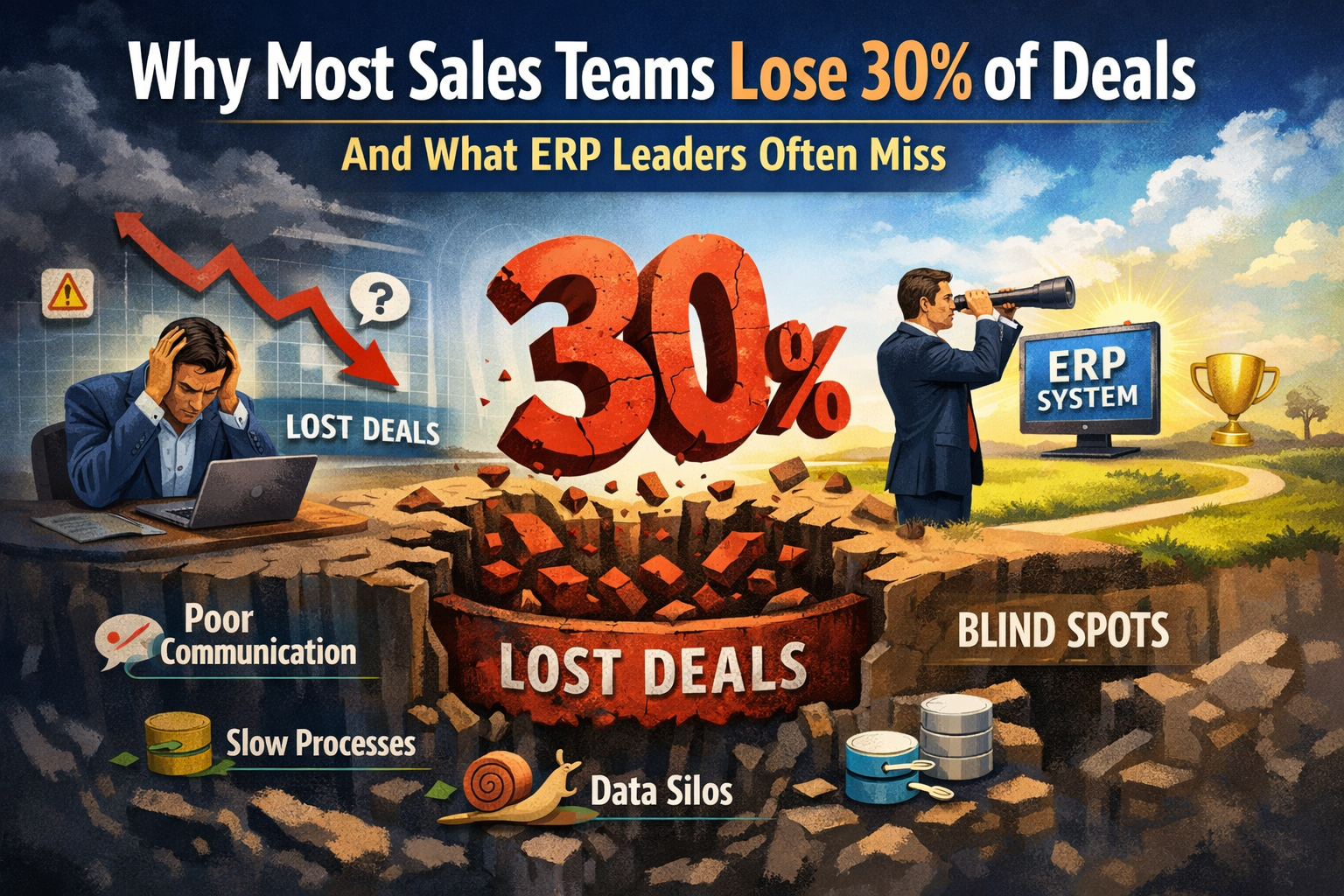
Why Most Sales Teams Lose 30% of Deals and What ERP Leaders Often Miss
In many sales-driven organizations, revenue loss does not occur because of poor leads or weak demand. Based on Apagen’s experience delivering ERP and CRM solutions across multiple industries, a significant portion of lost revenue happens inside the sales pipeline itself.
Across CRM audits and post-go-live reviews, we consistently see that nearly 30 percent of deals are lost due to broken follow-ups, inaccurate forecasting, and unstructured handling of lost opportunities. These issues often remain hidden when teams rely on spreadsheets, disconnected tools, or underutilized CRM platforms.
This ERP thought leadership article explains where these leakages originate, why traditional CRM usage fails to prevent them, and how disciplined practices using odoo crm software, demonstrated through an Odoo CRM Demo, help organizations improve sales outcomes sustainably.
The Hidden Cost of Informal Sales Processes
Many organizations operate sales pipelines using a combination of Excel sheets, emails, messaging apps, and partially configured CRM systems. While this approach may work initially, it becomes increasingly risky as deal volumes and team sizes grow.
From Apagen’s ERP consulting perspective, the challenge is not the absence of tools but the lack of process discipline. When follow-ups depend on individual memory or personal reminders, opportunities stagnate without visibility. Over time, this results in missed conversions and unreliable revenue projections.
Well-implemented odoo crm software replaces fragmented tracking with a single system of record, ensuring that every opportunity progresses through a defined and measurable process.
Why Sales Forecasting Breaks Down in Practice
Sales forecasting is expected to provide clarity to leadership, finance, and operations teams. However, many forecasts fail because they are based on deal values rather than realistic closure probability.
During Odoo CRM Demo sessions conducted by Apagen, we often demonstrate scenarios where large opportunities appear in forecasts despite having minimal chances of conversion. This creates inflated expectations and misaligned planning across the organization.
Odoo crm software calculates forecasts using a combination of opportunity value, sales stage, and probability of closure. This approach aligns forecasting with ERP principles by providing weighted, data-driven projections rather than optimistic assumptions.
Sales Stage Probability as an ERP Control Mechanism
One of the most common gaps identified during CRM implementations is missing or undefined sales stage probabilities. Sales stages exist visually, but they lack quantitative meaning.
In a governed ERP environment, each sales stage represents a level of confidence and commitment. Odoo crm software allows organizations to define probabilities at the stage level and refine them at the opportunity level when required.
For example, a newly created opportunity may carry a 10 to 20 percent probability, while a qualified opportunity may move to 30 percent or higher. When probabilities are applied consistently, forecasts become more accurate and defensible during management reviews.
Lost Opportunities as Strategic Data Assets
In many organizations, marking an opportunity as lost is treated as the end of the sales cycle. From an ERP thought leadership standpoint, this represents a missed learning opportunity.
Odoo crm software requires structured lost reasons, which can be configured centrally. Over time, this creates a valuable dataset that highlights patterns across industries, regions, and sales teams.
Based on Apagen’s experience, analyzing lost lead data helps leadership teams identify whether deals are being lost due to pricing issues, delayed responses, competition, or internal process gaps. This insight enables evidence-based strategy adjustments instead of guesswork.
To better understand how sales pipeline leakages happen and how forecasting, probability management, and lost lead nurturing work in practice, you can watch the detailed Odoo CRM Demo prepared by the Apagen consulting team below.
From Assumptions to Data-Driven Sales Strategy
When lost lead reasons are consistently captured and reviewed, sales strategy evolves from reactive correction to proactive improvement. Trends become visible that allow teams to refine qualification criteria, improve messaging, and address execution bottlenecks.
This shift aligns closely with ERP best practices, where performance improvement is driven by process optimization rather than individual effort alone. Odoo CRM Demo sessions often highlight how historical data supports smarter pipeline decisions.
Why “Lost” Does Not Always Mean Gone
A key insight from Apagen’s CRM implementations is that lost opportunities are often delayed rather than abandoned. In many industries, buying decisions depend on budget cycles, internal approvals, or timing constraints.
Odoo crm software supports lead nurturing and automation workflows that keep these opportunities engaged without aggressive selling. Automated follow-ups ensure that prospects are revisited at the right time, preserving long-term revenue potential.
From an ERP governance perspective, this approach treats customer relationships as long-term assets rather than one-time transactions.
Automation That Strengthens Sales Consistency
CRM automation is sometimes perceived as replacing human interaction. In practice, automation exists to enforce consistency and reduce dependency on individual discipline.
Using odoo crm software, routine actions such as follow-up reminders, nurturing emails, and opportunity restoration can be automated. This allows sales teams to focus on consultative conversations while ensuring that no opportunity is overlooked.
At Apagen, we position automation as a reliability layer that supports sales teams rather than controlling them.
Preserving Context When Opportunities Are Revived
When previously lost opportunities return to the pipeline, context is critical. Sales teams must understand past discussions, objections, and reasons for delay.
Odoo crm software ensures that restored opportunities retain their history, stages, and communication records. This continuity improves customer experience and avoids repetitive or disconnected conversations.
From an ERP architecture standpoint, this reinforces the principle of maintaining a single source of truth across the customer lifecycle.
Measurable Business Impact of Structured CRM
Across Apagen-led ERP and CRM implementations, organizations that adopt structured CRM practices consistently see measurable improvements. These include better forecast accuracy, improved conversion rates, and more predictable revenue planning.
While outcomes vary by industry and maturity, improvements of approximately 30 percent in sales efficiency are common when odoo crm software is implemented as part of a governed ERP strategy rather than a standalone tool.
CRM as an Extension of ERP Strategy
An important message we emphasize during every CRM is that CRM should not operate in isolation. It must integrate with finance, operations, and delivery processes.
When odoo crm software functions as an extension of ERP strategy, sales decisions align more closely with operational capacity and long-term business goals.
Closing Perspective
Based on Apagen’s experience delivering ERP and CRM solutions, most sales organizations already have sufficient demand. The real challenge lies in managing that demand with discipline, visibility, and data-driven processes.
Revenue leakage rarely happens suddenly. It occurs quietly through missed follow-ups, unrealistic forecasts, and forgotten opportunities. Addressing these issues through structured CRM practices delivers sustainable improvement without aggressive selling.
True sales performance improvement begins when CRM is treated as a governed business process supported by ERP principles, not just another piece of software.

No Comments
Sorry, the comment form is closed at this time.